





 Analysis by Gamescozy
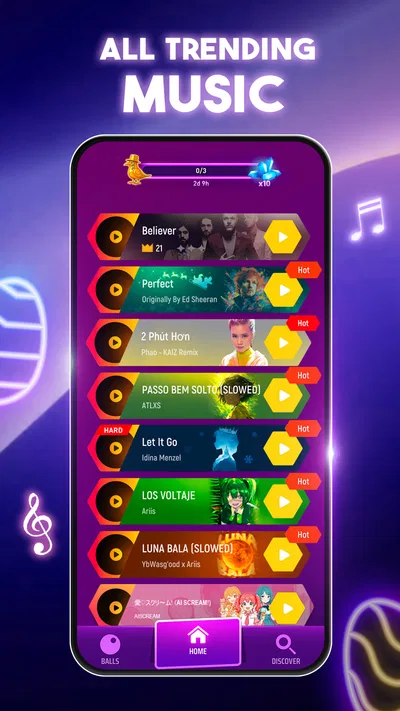
I understand the appeal of a game that turns a spare minute into a small test of rhythm and focus. Tiles Hop is a music game built around guiding a bouncing ball across a path of tiles, keeping pace as the track plays. Its basic idea is easy to grasp, but the timing makes it more engaging than a passive music player: a brief lapse in attention can send the ball off course. I found it best when I wanted something lively and immediately playable, rather than a game that asks me to learn a complicated system before I can enjoy it.
Why the first sessions click
The first-week appeal comes from the direct connection between sound and movement. You listen for the beat, watch the route ahead, and steer the ball from tile to tile. That makes each attempt feel active without requiring a long tutorial or a big time commitment. A song can turn a simple sequence of taps into a little concentration exercise, and a mistake gives you an obvious reason to try again.
As a music game from AMANOTES PTE. LTD., it sits between rhythm games that ask you to hit fixed notes and casual arcade games that focus mainly on movement. Here, the music is central to the feel, but the challenge is also visual: you need to read the path and react in time. That combination gives it a different texture from tapping notes in straight lanes or simply listening to a playlist while playing something unrelated.
That immediacy is useful in ordinary moments. I can imagine opening it while waiting for a coffee, taking a short break between tasks, or handing the phone to someone who wants to try a quick round. You do not need to set aside an evening to get something out of it. The trade-off is that it rewards attention rather than background play; if you are trying to listen closely to a conversation or do another task at the same time, the timing can quickly become frustrating.
The game is free to download and has in-app purchases ranging from $0.99 to $49.99 per item. That makes it easy to try without an upfront purchase, but I would treat optional spending as a personal choice rather than a requirement for deciding whether the core experience suits you. The age rating is Everyone 10+, a useful detail for families considering it, though I would still check the app store page and device settings before letting a child make purchases.
How to make early play feel fair
My most practical advice is to start with the phone held steady and the sound clear enough to follow the beat. If the device is moving around in your hand or the audio is difficult to hear, it becomes harder to tell whether a miss came from your timing or your setup. I also find it more satisfying to replay a short section with a specific goal—such as staying focused through a tricky transition—than to keep restarting without noticing what went wrong.
There is a small but important distinction between reacting to the ball and anticipating the route. Staring only at the ball can make changes in direction feel abrupt; looking slightly ahead gives you more time to prepare. That is a useful adjustment for anyone who finds the first attempts chaotic. It does not remove the challenge, but it shifts the game from frantic tapping toward reading the rhythm and path together.
What keeps it in rotation
The longer-term question is whether the central loop has enough staying power after the novelty of a bouncing ball wears off. For me, its recurring value depends on whether I enjoy improving my timing and returning for short, focused sessions. It works well as a compact habit: open it, play while I have a few minutes, then put it away. It is less compelling if I expect a deep campaign, a broad story, or a constantly changing set of activities.
Its scale is part of the charm. A large game can feel like an obligation when I only have a short break, while this sort of rhythm challenge is easy to pick up without planning. The same simplicity, however, places more weight on the feel of the music and the moment-to-moment play. If those stop holding your attention, there may not be enough variety in the basic premise to make every session feel fresh.
One way I would keep it from becoming repetitive is to set a modest personal target rather than treating every session as a score chase. For example, I might play a few attempts, notice where my timing slips, and stop once I have made a more controlled run. This turns the game into a small skill practice instead of an endless loop of retries. It is especially helpful when a difficult section tempts you to keep playing long after the break you intended to take.
The audience response suggests that plenty of players find the format appealing: it has a 4.3 average from around 3.4 million ratings, alongside roughly 80,000 written reviews. Those figures are useful context, not a guarantee that the game will suit every rhythm-game fan. Players who want precise note charts, a strong sense of musical authorship, or a more elaborate progression structure may prefer a different kind of rhythm title. Tiles Hop is at its best when quick accessibility matters more than depth.
Practical limits and upkeep
The game’s current version is 8.18.1, and it supports Android 7.0 and later. If you are deciding whether an older Android device can run it, that minimum requirement is the detail to check against your phone’s software version. The game has accumulated over 500 million installs, but that scale does not change the basic point: a compatible device and a comfortable way to hear the beat matter more to your own experience than popularity alone.
In terms of maintenance, this is not the sort of game that needs a complicated routine from the player. I would keep it updated through the app store, pay attention to the space available on the device, and review purchase settings if a child shares the phone. Those are ordinary habits, not a special burden unique to the game. The greater practical friction is deciding whether you want to spend time in a repeat-focused game at all, especially if you already have several casual games competing for the same spare minutes.
Because the core interaction relies on timing and concentration, the conditions around play can affect enjoyment. A noisy room, low phone volume, or interruptions can make a run feel unfair even when the game itself is behaving normally. I would choose a short, relatively quiet break rather than try to squeeze in a serious attempt while distracted. Conversely, if you only want a few casual taps and do not mind imperfect runs, it can still serve as a light time-filler.
Where fatigue can set in
The main source of fatigue is repetition. The same basic act—steering a ball along a musical path—can be satisfying when I am improving, but less rewarding once I feel I have seen enough of the pattern. A retry loop is motivating for someone who likes polishing reactions; it can feel like busywork to someone who wants each session to introduce a new mechanic or a meaningful change in direction.
There is also a difference between enjoying music and enjoying a game that uses music as a timing guide. If your priority is to discover songs, build playlists, or listen without visual demands, a dedicated music app is a better choice. If you prefer rhythm games with deliberate note patterns and a more structured sense of performance, a lane-based alternative may suit you more. I would choose Tiles Hop for quick, visually guided rhythm play, not as a replacement for either of those experiences.
In-app purchases are another point to consider over time. The game is free, but the listed item prices range from $0.99 to $49.99, so it is sensible to decide in advance whether you are comfortable with optional spending. I would not let the presence of purchase options pressure me into paying before I know whether I am still enjoying the core loop after several sessions. For a casual player, setting purchase controls on a shared device is a simple way to avoid an unwelcome surprise.
What I would watch for in my own routine is whether I open it because I genuinely want a short challenge or simply because it has become an automatic way to fill every idle moment. A game earns a lasting place when it continues to feel rewarding, not just familiar. If I find myself restarting without paying attention, or feeling annoyed rather than curious after a miss, that is a good sign to take a break. Its pick-up-and-play nature makes returning easy, but it does not mean every spare moment needs to become a session.
Who should keep it installed
I would recommend it to someone who likes music-led reflex games, enjoys improving through repetition, and wants an activity that can fit into brief breaks. It is also approachable for a casual player who does not want to learn a complicated control scheme before getting started. The blend of beat awareness and route reading gives it more of a hands-on feel than a simple tap-along, while remaining easy to understand at a glance.
I would be less likely to recommend it to someone who gets impatient with retries, needs a substantial sense of progression, or wants a game that remains interesting during long sessions. It may also be the wrong choice if you mainly want music in the background, since successful play asks you to pay attention to the screen and sound. In those cases, a conventional music player or a more structured rhythm game is a better match than trying to make this one serve a different purpose.
Does it earn lasting space?
For me, Tiles Hop earns a place as an occasional, low-commitment rhythm challenge rather than an essential daily game. Its strongest quality is how quickly it turns a song and a simple control idea into an active test of timing. Its weakness is the matching simplicity: once the loop stops feeling fresh or skill-building, there is a real chance it will slide out of your routine. The best reason to keep it is that you enjoy the short sessions themselves, not the hope that it will eventually become a deeper game.
At the time of writing, the game has been available since January 16, 2018, and its scale—more than 500 million installs—shows how widely its straightforward format has travelled. I would still make the decision personally: try it for the short breaks it is built to fill, keep spending optional, and notice whether you are coming back for the rhythm or merely out of habit. If that quick burst of concentration continues to feel good, it is an easy game to keep around; if you want richer musical structure or more varied play, you can move on without missing what makes it appealing.
My verdict: Tiles Hop is a lively, accessible pick for brief music-game sessions, with enough timing challenge to make a quick round feel active. I like it most as a small skill test between other things, and least when I expect long-term variety from one simple loop. That makes it easy to recommend to the right person—and just as easy to skip if repetition is not your kind of fun.